
As Canada's HVAC industry transitions from R410A to R32, many technicians are asking the same questions:
- Does R32 operate at a higher pressure?
- Does it require less refrigerant?
- Can I top off an R32 system after a leak?
- Does being a single-component refrigerant change servicing?
- Is transporting and storing R32 more dangerous?
- The good news is that while R32 introduces a few new considerations, the transition is much easier than many technicians expect.
1. Does R32 Operate at a Higher Pressure?
Yes—but only slightly.
Under normal operating conditions, R32 operates at pressures similar to R410A, typically only 2–8% higher, depending on system design and ambient conditions.
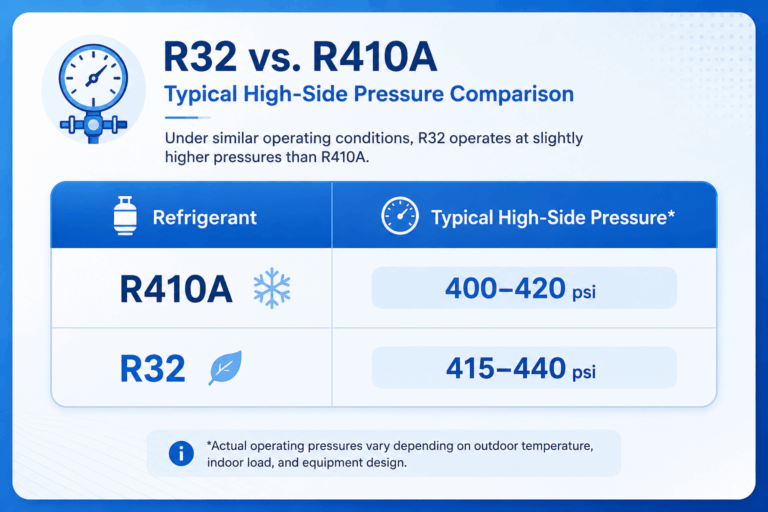
* Actual operating pressures vary depending on outdoor temperature, indoor load, and equipment design.
For technicians, this means:
- Expect slightly higher gauge readings.
- Most gauges rated for R410A pressure ranges can measure R32 operating pressures.
- R32 equipment is specifically engineered for these pressures—R410A systems should never be retrofitted with R32.
2. Why Does R32 Require Less Refrigerant?
One of R32’s biggest advantages is its improved thermodynamic performance.
Compared with R410A, R32 offers:
- Approximately 12% higher volumetric cooling capacity
- Higher refrigerating effect per unit mass
- Higher potential system efficiency
These characteristics allow manufacturers to achieve the same cooling performance using approximately 20–30% less refrigerant.
For example, a system requiring 2.5 kg of R410A may only require 1.8–2.0 kg of R32.
A lower refrigerant charge not only reduces environmental impact but can also improve overall system efficiency.
3. Single-Component vs. Blend: Why It Matters
This is one of the biggest practical differences technicians will notice.
R410A is a blended refrigerant.
Because it contains multiple components, its composition may change after a significant refrigerant leak. For this reason, technicians should:
- Charge as a liquid.
- Avoid simply topping off systems after major leaks.Recover, evacuate, and recharge by weight whenever refrigerant composition may have changed.
R32 is a single-component refrigerant.
Since there is no risk of fractionation:
- Refrigerant composition remains consistent if leakage occurs.
- Recovery is more straightforward.
- After repairing a minor leak, topping off may be permitted by the equipment manufacturer and local regulations. Always follow the manufacturer’s service instructions.
4. Do I Need Different Tools?
Not necessarily.
Most manifold gauges designed for R410A pressure ranges can be used to measure R32 operating pressures.
However, because R32 is classified as an A2L mildly flammable refrigerant, technicians should ensure that service equipment is approved for use with A2L refrigerants where required.
This may include:
- Leak detectors
- Recovery machines
- Recovery cylinders
- Other A2L-compatible service equipmentTransporting and Storing R32 Systems?
5. Transporting and Storing R32 Systems
Because R32 is classified as an A2L mildly flammable refrigerant, both refrigerant cylinders and factory-charged equipment should be handled appropriately during transportation and storage.
For Refrigerant Cylinders
- Store cylinders upright and secured.
- Keep cylinders in a cool, well-ventilated area.
- Avoid open flames, sparks, and excessive heat.
- Do not leave cylinders inside enclosed service vehicles for extended periods without adequate ventilation.
- Follow all local transportation and fire safety regulations.
For Factory-Charged Equipment
Factory-sealed R32 indoor and outdoor units are designed to be transported safely through normal distribution channels. However, technicians should still follow good handling practices:
- Transport equipment in an upright position whenever possible.
- Avoid impacts, punctures, or damage to refrigerant piping.
- Store equipment in a dry, well-ventilated area.
- Keep units away from ignition sources and excessive heat.
- Inspect equipment for shipping damage before installation.
For most technicians, transporting and storing R32 equipment is very similar to handling today’s R410A systems—the main difference is understanding and following A2L safety requirements.
Final Takeaway
The transition to R32 is about more than reducing Global Warming Potential (GWP). It also delivers improved efficiency while keeping installation and service procedures familiar for HVAC professionals.
Here’s what every technician should remember:
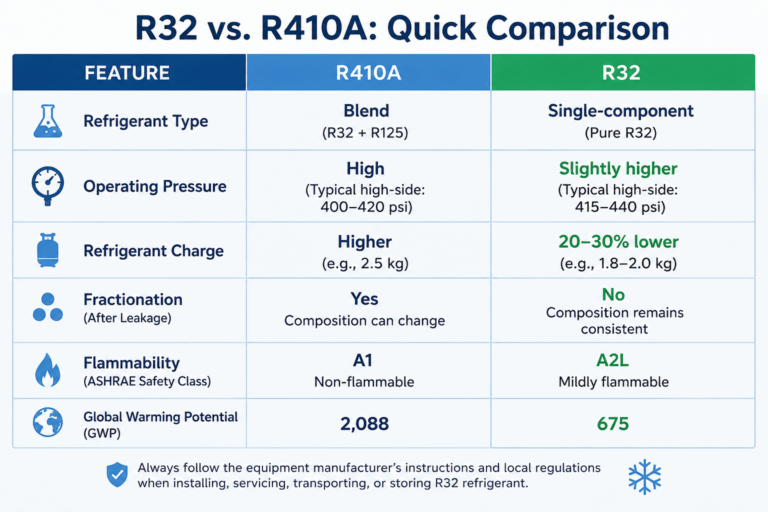
With proper A2L training, compatible service equipment, and an understanding of these key differences, HVAC technicians can confidently install and service the next generation of R32 systems.
Great content! Keep up the good work!